In brief
- 🚰 Hard water carries calcium and magnesium that stick to surfaces and start mineral buildup almost everywhere water flows.
- 🧱 Limescale narrows pathways in valves, aerators, and supply lines, which can feel like “mysterious” low pressure.
- 🔧 Plumbing fixtures take the hit first: clogged shower nozzles, crusty faucet aerators, sticky cartridges, and leaky seals.
- ⚠️ Old copper and galvanized systems face faster pipe corrosion, especially at joints and mixed-metal connections.
- 💸 The real cost shows up in extra maintenance, higher energy use (especially water heaters), and early fixture replacement.
- 🧼 Cleaning gets harder: soap scum forms faster, detergents work worse, and “clean” still looks spotty.
- 🧪 Testing water hardness (GPG/PPM) makes the problem measurable—and easier to fix strategically.
- 🛠️ A whole-home softener plus targeted habits (descaling, flushing, better fixtures) is usually the most effective combo.
Hard water looks harmless when it’s pouring clear into a glass, but it behaves like a slow, gritty tax on your home. Day after day, dissolved calcium and magnesium ride along with every shower, every dish cycle, every handwash—then quietly drop out of solution when conditions change. The result is limescale: a chalky, stubborn crust that clings to the parts of your plumbing you see, and many you don’t. It doesn’t need a dramatic “failure moment” to do damage, either. It just steadily tightens up aerators, gums up showerheads, roughens valve seats, and turns smooth water paths into turbulent channels that waste pressure and wear parts faster.
In places where hard water is common—think older neighborhoods around large metro areas with limestone-rich geology—people often notice the cosmetic stuff first: spots on glassware, soap scum that laughs at your sponge, white rings around drains. The bigger story is what’s happening inside plumbing fixtures and supply lines. Scale changes how water moves, how seals seat, and how metals age. If you’ve ever wondered why a “good” faucet suddenly feels gritty, or why a shower goes from spa-like to sad in a couple of years, the answer is often sitting there in plain sight as a white crust you’ve been scraping for months.
Hard Water and Plumbing Fixtures: What’s Really in Your Water (and Why It Sticks)
Let’s get practical: hard water is water with a higher concentration of dissolved minerals—mainly calcium and magnesium. These ions hitch a ride as water moves through limestone and chalk deposits underground. None of that is scary from a drinking perspective for most households, but it’s brutal for hardware designed with tiny passages, rubber seals, and precision parts.
Water hardness is typically measured in grains per gallon (GPG) or parts per million (PPM). Once you’re above roughly 7 GPG, most homeowners will start seeing real-world effects. The key is that “hard” isn’t a vibe—it’s a number you can test, track, and use to decide what to do next.
Why limescale forms faster than you expect
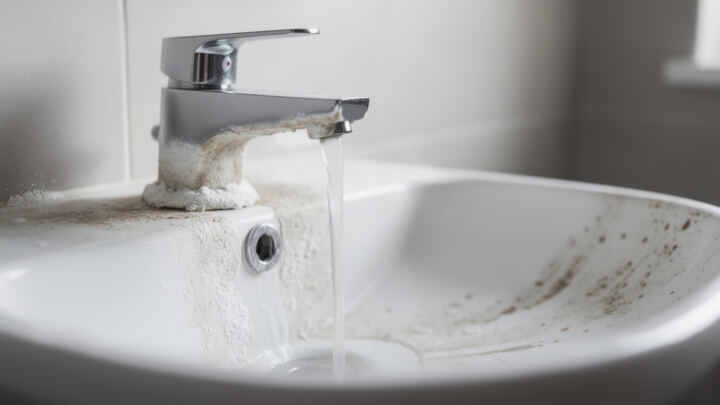
Scale doesn’t show up because your water is “dirty.” It forms because minerals fall out of the water when conditions change—like when water is heated, when pressure shifts, or when it splashes and evaporates on a faucet. That’s why shower doors and spouts get crusty so fast: the water leaves, the minerals stay.
Here’s a simple mental image. Picture a coffee maker that’s never been descaled. The same kind of mineral buildup happens in faucet aerators and showerhead nozzles—just in smaller pathways, where a little crust has an outsized impact.
How to confirm you’re dealing with hard water (not a random plumbing gremlin)
Home test strips are quick, but you can also cross-check with your municipal water report and then verify with a hardness test kit for your specific tap. People love to blame “low city pressure,” but a lot of the time the restriction is local—right at the fixture.
- 🔎 White, chalky residue around spouts and handles
- 🫧 Soap that won’t lather easily; more shampoo and detergent used
- 🍽️ Spots and film on dishes and glassware after washing
- 🧺 Laundry that feels stiff or looks dull
- 🚿 Gradual pressure drop at one fixture (not the whole house)
- 🧴 Dry skin or hair that feels “coated” after showering
If your home has a mix of symptoms—especially fixture-specific pressure issues—hardness is a prime suspect. The next step is understanding how that scale interacts with the actual components you rely on every day.
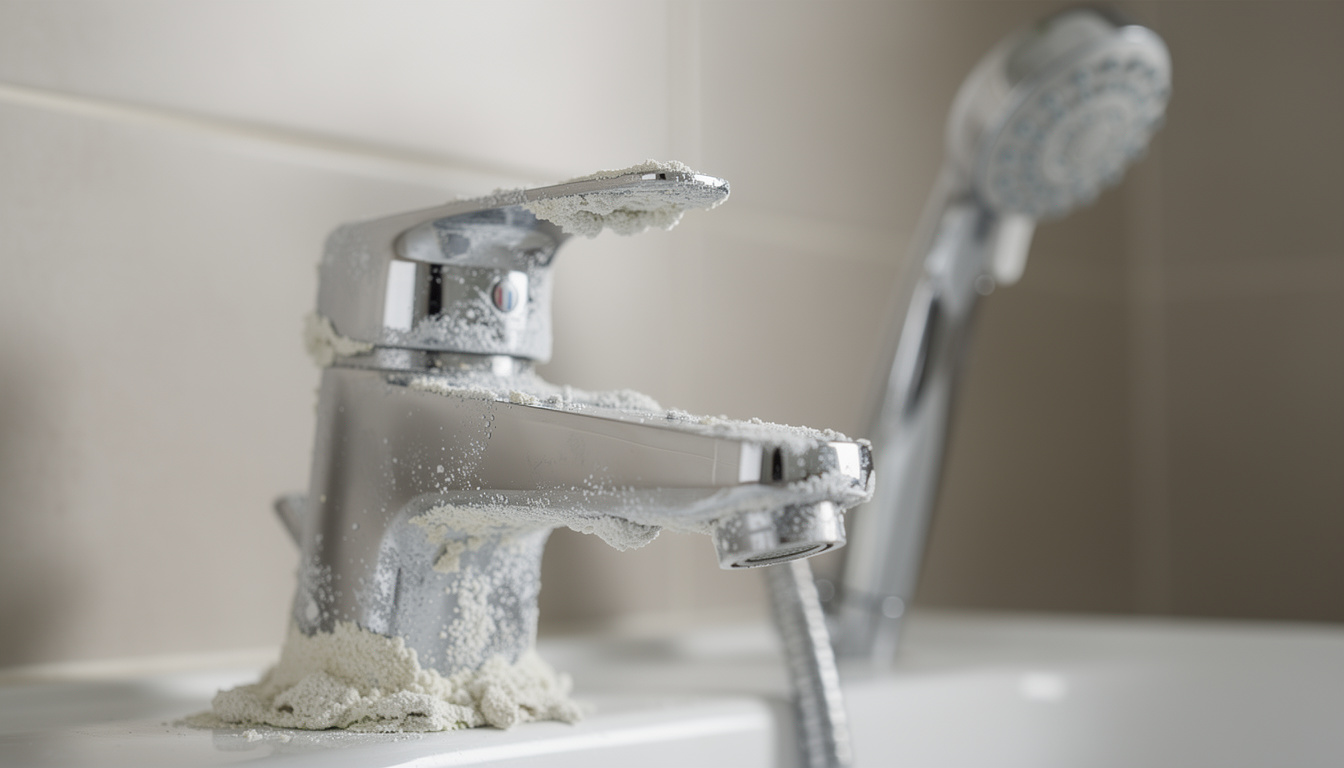
Limescale Buildup and Fixture Damage: How Faucets, Showerheads, and Valves Lose Performance
Fixtures are basically small machines. Inside a typical faucet you’ll find aerators, cartridges, O-rings, valve seats, and sometimes thermostatic mixing components. These aren’t built for rocks. Yet that’s effectively what limescale becomes over time: a brittle mineral layer that narrows openings, roughens surfaces, and prevents tight sealing.
Faucet aerators: the tiny part that causes big frustration
Aerators are designed to shape flow and reduce splashing, using a mesh screen and small channels. They’re also a perfect trap for calcium deposits. As the openings narrow, flow can look “fine” at first but become uneven, sideways, or sputtery. People often replace the faucet when the fix is a $5 aerator and a cleanup.
Example: Maya, in a 1960s brick bungalow, noticed her kitchen faucet was blasting at a weird angle and taking longer to fill pots. The household pressure gauge at the outdoor spigot looked normal. The culprit was a half-blocked aerator with a hard white crust. A vinegar soak restored it, but the deposits returned within weeks—because the water chemistry never changed.
Showerheads: when clogged nozzles ruin the “feel” of your water
With showerheads, scale clogs the spray nozzles and creates uneven patterns: needle jets, dead zones, and that annoying “one cold stream” effect as the mix shifts. If you have a rain showerhead, the impact is even more noticeable because it relies on many small outlets.
A quick tactic is a vinegar soak (bag-and-rubber-band overnight). It’s cheap and it works, but it’s also a clue: if you have to do this constantly, you’re treating symptoms, not the cause.
Cartridge and valve wear: the hidden side of fixture damage
Scale doesn’t just block flow; it makes moving parts grind. Cartridge-style faucets can start feeling stiff, crunchy, or inconsistent because mineral deposits interfere with smooth rotation and sealing. When seals don’t seat properly, micro-leaks start. You might not notice right away—until the handle area gets damp, the cabinet base swells, or you’re suddenly replacing a “perfectly good” faucet far earlier than expected.
That’s the annoying truth: fixture damage from hard water is often gradual. It’s not a single event. It’s a slow decline in performance that looks like “normal aging,” even when it’s preventable. Next up is what happens when the same mineral story moves beyond fixtures and into the piping that feeds them.
If you’re curious what a descaling process looks like in real life, it’s worth seeing a few demonstrations—because technique matters more than people think.
Pipe Corrosion and Clogged Pipes: What Hard Water Does Behind the Walls
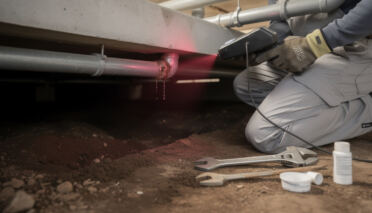
Once you move past the visible fixtures, hard water’s long game is all about restriction and material stress. Inside the plumbing network, mineral buildup can coat pipe walls, especially in older systems. Over time that can contribute to clogged pipes, pressure inconsistencies, and increased strain on joints and fittings.
How mineral buildup narrows pipes over months and years
Scale accumulation is a bit like cholesterol in an artery—except it’s rock-like and it changes flow dynamics. As interior surfaces get rougher, they attract more deposits. That “snowball” effect is why some homes go from “a little hard water annoyance” to “why is the upstairs shower so weak?” faster than expected.
One practical way to monitor: time how long it takes to fill a one-gallon container at key fixtures. Do it every few months. If you see a consistent decline at specific taps, local buildup is likely. For a broader check, a simple pressure gauge on an outdoor spigot can tell you whether the issue is supply-side or internal.
Pipe corrosion: why metal choice and age matter
Pipe corrosion can accelerate in systems with copper or galvanized steel, especially at joints, fittings, and mixed-metal connections where galvanic reactions are more likely. Hardness minerals don’t “cause” every corrosion issue, but they can contribute to conditions that make deterioration easier—particularly when water chemistry, oxygen exposure, and temperature cycles line up poorly.
Warning signs that deserve attention: rusty or blue-green tinted water, metallic taste, pinhole leaks, and recurring clogs that keep coming back even after cleaning. Those aren’t just inconveniences; they’re signals that the system is changing internally.
Drain and trap problems: when scale becomes a debris magnet
Hard water deposits can also roughen drain interiors. That matters because rough surfaces catch hair, soap scum, grease, and small food particles. Suddenly your “normal” shower shedding becomes a slow-drain situation. You clear the clog, it returns, and the cycle repeats because the pipe wall itself has become stickier.
This is where a lot of homeowners get stuck paying for repeated snaking without addressing the underlying condition. The insight to keep: when hard water is the environment, cleaning is only temporary unless you change the environment. And the next biggest victim of that environment is usually the water heater.
Water Heater and Appliance Stress: Energy Waste, Wear, and Water Quality Side Effects
Water heaters are basically scale factories when hardness is high. Heating changes mineral behavior, so calcium and magnesium are more likely to settle out and coat surfaces. The heater then works harder, runs longer, and quietly drains efficiency.
Efficiency loss: how a thin layer of scale turns into real money
A relatively small layer of scale can act like insulation between the heat source and the water. In real household terms, that translates into longer recovery times and higher utility bills. Many plumbers still reference the rule-of-thumb that even around a quarter-inch of scale can push energy consumption dramatically higher—sometimes up to about 40% in worst-case scenarios—because heat transfer gets so much worse.
In 2026, with energy prices still volatile in many regions, that kind of inefficiency isn’t abstract. It’s the difference between a water heater that quietly does its job and one that’s always playing catch-up.
Appliance wear: dishwashers, washing machines, and the soap problem
Hard water messes with cleaning chemistry. Calcium and magnesium bind with soap and detergent, forming soap scum instead of staying dissolved. Cleaning performance can drop significantly—people often cite reductions around 40% in tough conditions—so you use more product and still get worse results: spotty glassware, stiff clothing, and gray-looking whites.
Even worse, deposits collect on spray arms, filters, and heating components. Over time, that can shorten appliance lifespan dramatically. It’s common to see talk of 30–50% lifespan reduction in homes that never treat hardness and rarely descale.
Water quality: not just taste—materials and contamination risk
Water quality isn’t only about minerals. If hard water contributes to material wear in older metal plumbing, there’s a separate concern: corroding pipes can release metals into the water stream. That’s most relevant in older homes with aging copper or galvanized lines. If you notice metallic taste, unusual staining, or you’re renovating and discover old mixed-metal runs, it’s smart to test your water beyond hardness alone.
| Area impacted | What hard water does 🧱 | What you notice at home 👀 | Most useful action 🛠️ |
|---|---|---|---|
| Faucet aerators | Limescale blocks mesh and channels | 🚰 Side-spraying, reduced flow | 🧼 Remove + vinegar soak; replace aerator if needed |
| Showerheads | Minerals clog nozzles and internal passages | 🚿 Uneven spray, weak pressure | 🧴 Descale; consider anti-scale or easy-clean models |
| Valves/cartridges | Deposits roughen seals and moving parts | 🔧 Stiff handles, drips, inconsistent mixing | 🧰 Replace cartridge; treat hardness upstream |
| Water heater | Scale insulates heat surfaces | 🔥 Longer recovery, higher bills | 🧯 Flush tank; schedule descaling; soften supply |
| Drain lines | Rough scale traps debris | 🌀 Slow drains, recurring clogs | 🧹 Clean + maintain; address the hardness source |
Once you see how fixtures, pipes, and heaters all connect, it becomes obvious that “cleaning more” isn’t a strategy. The next section is about choosing fixes that actually stick—without turning your home into a science project.
Maintenance and Solutions: Softening, Descaling, Smarter Fixtures, and Real-World Routines
The goal isn’t perfection—it’s control. You want fewer deposits, fewer surprise failures, and less time scrubbing white crust off chrome. The best plan usually combines one “system-level” fix with a few habits that keep things from backsliding.
Whole-home water softeners: why they’re the heavy hitter
A water softener reduces calcium and magnesium before the water enters your home’s distribution lines. Salt-based ion exchange systems are the classic option; salt-free conditioners can reduce scale adherence in different ways, depending on technology. Either way, the big win is that you’re attacking the cause upstream instead of constantly reacting at each fixture.
Cost-wise, installed systems are often in the ballpark of $800–$2,500 depending on capacity, plumbing complexity, and local labor rates. That sounds like a lot—until you compare it to emergency repairs: pipe replacement incidents can run $1,500–$4,000, and water heater replacement can land around $900–$3,000 depending on type and venting. In many households, reducing scale pays back through fewer breakdowns and lower energy waste within a few years.
Descaling and flushing: what “maintenance” should look like
Maintenance matters even if you soften your supply, because older scale doesn’t magically vanish overnight. A sensible routine includes flushing the water heater, inspecting aerators, and cleaning fixtures before small restrictions turn into performance problems.
- 🗓️ Every 1–3 months: check faucet aerators and showerhead spray patterns; clean if flow looks uneven.
- 🧴 Monthly (especially for hard areas): run an empty dishwasher cycle with vinegar (where manufacturer allows) or an approved descaler; wipe seals and filters.
- 🔥 Every 6–12 months: flush the water heater tank (more often in very hard regions).
- 🔍 Once a year: have a plumber inspect for early leaks, valve wear, and pressure irregularities.
A quick note: some appliance brands recommend specific descalers rather than vinegar, especially for newer models with sensitive components. Always follow the manual—saving $3 on vinegar isn’t worth voiding coverage.
Upgrading fixtures: choosing designs that fight buildup
If you’re already replacing fixtures, pick models that are easier to maintain: showerheads with rubber nozzles you can rub clean, faucets with accessible aerators, and valves known for durable cartridges. Some finishes also show spotting less dramatically, which won’t stop scale but will reduce the “always dirty” look.
Think of it like buying shoes for your climate. If you live with hard water, choose plumbing fixtures that assume scale will happen and make cleaning painless. Pair that with a softener or conditioner, and you stop living in a loop of scrubbing and swapping.
The bottom line insight: hard water doesn’t demand constant frustration—it demands a plan that matches how the minerals behave in real homes.
How hard is ‘hard’ when it comes to water hardness?
Most households start noticing problems once water hardness is above about 7 grains per gallon (GPG). Testing with strips or a proper kit (and comparing to your local water report) helps you decide whether you need a softener, a conditioner, or just more targeted maintenance.
Can hard water really cause clogged pipes, or is that exaggerated?
It’s real. Mineral buildup can line pipe interiors and narrow the effective diameter over time, especially in older plumbing. The restriction can reduce flow, create pressure changes, and make drains more prone to catching debris—so you see recurring clogs rather than a one-time blockage.
What’s the fastest way to improve shower pressure if limescale is the issue?
Start with the showerhead: remove it and soak it in a descaling solution (often vinegar, if compatible) to dissolve scale. Also check the flow restrictor and the supply valve is fully open. If pressure is still poor at only that bathroom, scale may be affecting the valve or supply lines.
Does a water softener fix fixture damage that already happened?
It prevents new scale from forming at the same rate, which protects fixtures going forward. Existing limescale may still need manual descaling, and worn cartridges, seals, or corroded parts may require replacement. Think of softening as stopping the bleeding, not reversing all scars.
Should I test water quality for metals if I suspect pipe corrosion?
Yes—especially in older homes with copper or galvanized steel plumbing. If you notice metallic taste, discoloration, or blue-green staining, do a targeted water test for metals in addition to hardness. It’s a practical way to separate mineral nuisance from a potential health and plumbing risk.