In brief
- 🚰 Your home layout for plumbing is basically two big networks: water supply in, and drainage out—plus vents that keep everything flowing.
- 🧭 Learn where your valves are (main and fixture-level) so a small leak doesn’t turn into a soaked ceiling.
- 💨 Vents protect traps and stop sewer system smells by balancing air so water can drain without “glug-glug” drama.
- 🧰 The right pipes, fittings, and sealants matter; mismatching materials is a classic DIY mistake.
- 📉 Watch for early warning signs: stains, gurgling, odor, low water pressure, or surprise bill spikes.
- 🧼 Simple maintenance (inspection, drain covers, gutter care) extends system life and prevents nasty backups.
Your home’s plumbing is one of those “out of sight, out of mind” systems—right up until it isn’t. A weird sewer smell in the laundry room, a kitchen sink that suddenly drains like it’s thinking about it, or a mystery stain that blooms on the ceiling after a shower: all of that usually traces back to the same thing. The home layout of your pipes, vents, fixtures, and valves was designed to move clean water in and move dirty water out, quietly, safely, and reliably. When you understand the map, you stop guessing—and you start making smart calls, whether you’re tightening a supply line, planning a remodel, or figuring out why the basement drain smells like a subway station.
In real houses, plumbing isn’t a neat diagram—it’s a living network shaped by past renovations, local code, and the choices builders made to save time, space, or money. To keep things grounded, we’ll follow a fictional homeowner, Maya, who bought a 1990s two-story place and is slowly upgrading it. Her goal isn’t to become a master plumber. She just wants to understand how water moves through her walls, how the sewer system connection behaves, and what “normal” looks like—so she can spot problems early and keep repairs from getting expensive.
Understanding Your Home’s Plumbing Layout: Water Supply vs. Drainage (and Why Vents Matter)
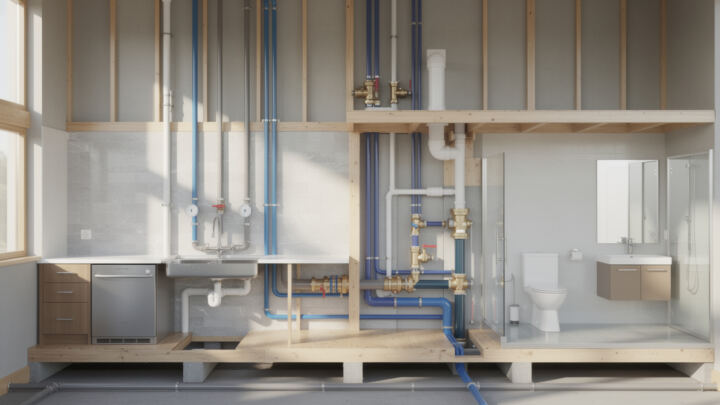
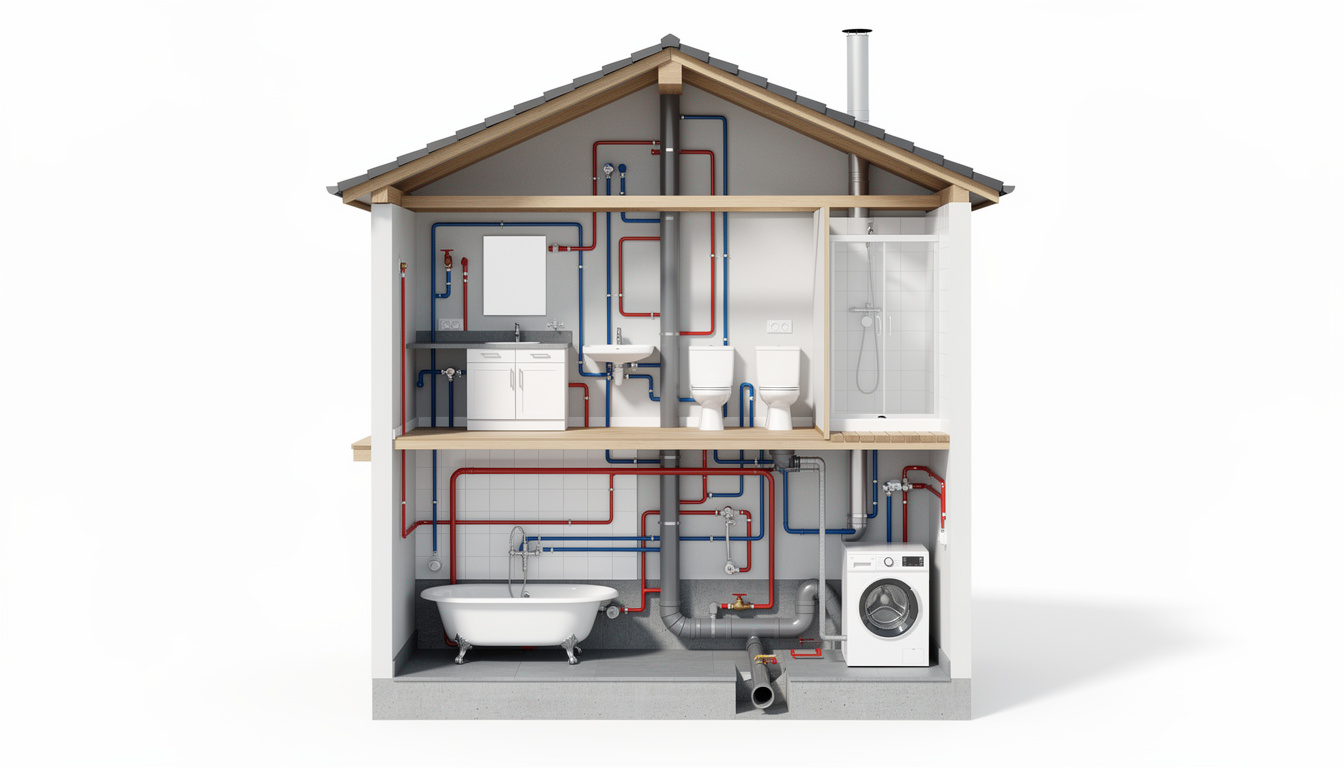
Think of residential plumbing as two main highways that barely interact. The first is the water supply network: pressurized lines bringing clean water to sinks, toilets, showers, and appliances. The second is the drainage side (often called DWV—drain, waste, vent): larger pipes that carry used water and waste away using gravity, while venting keeps air pressure balanced. If you only remember one thing, make it this: supply is pressure-driven; drainage is gravity-driven. That difference explains most weird symptoms.
Maya’s first “aha” moment came when she realized why the toilet fills quickly but the shower drain depends on slope. On the supply side, water arrives from either a municipal feed or a private well, hits the main line, and then branches out. Cold water goes straight to many fixtures, while another branch feeds the water heater. Hot water then travels through separate hot lines to taps, dishwashers, and showers. It’s not a literal loop in most homes, but it behaves like a controlled distribution network where water pressure is the engine.
The drain side works more like a slide than a pump. Every sink and tub connects to a drain line that should slope consistently toward the main stack and eventually out to the building sewer. The catch is that gravity drainage needs air to work smoothly. Without venting, water moving through a pipe can create a vacuum and slow everything down. The easiest analogy is the tiny air hole on a to-go cup lid: cover it, and the drink “glugs” because air can’t replace the liquid smoothly. Same physics, different mess.
How venting protects flow and indoor air quality
Vent pipes let air enter the system and let gases exit above the roofline. That matters for two reasons. First, it keeps drains moving at a steady pace, preventing that slow, hesitant drain that makes you think you need drain cleaner (you often don’t). Second—and this is the big one—vents protect trap seals. Under most sinks you’ll find a U-shaped curve called a P-trap, which holds a little water. That water barrier blocks sewer gases from coming back into the home. 🚫💩
If the system isn’t vented correctly, a strong rush of water can siphon the trap dry. Once that seal is gone, gases from the sewer system can seep into rooms. Maya saw this in a guest bath that was rarely used: the room sometimes smelled “off,” especially on windy days. The fix wasn’t exotic—running water regularly kept the trap full, and checking the vent path reduced pressure issues. In tricky remodels, some homes use air admittance valves (AAVs) to add airflow where running a traditional vent is impractical, but code rules vary, so this is one of those “verify before you install” moves.
The takeaway is simple: if you’re mapping your home layout, don’t just trace where water goes—trace where air goes too. That’s the hidden key that makes drainage behave, and it’s the difference between “it works most days” and “it works all the time.”
Mapping the Home Layout of Pipes and Fixtures: Reading Your House Like a Plumbing Blueprint
You don’t need official construction drawings to understand your plumbing. You need a method. Maya started by walking the house and listing every water-using thing—every sink, toilet, shower, hose bib, dishwasher, fridge line, washer—then grouping them by wall. Most homes are designed with “wet zones” stacked or clustered because it saves materials and makes venting easier. When a bathroom sits above a kitchen, that’s rarely random—it’s efficiency.
A practical trick is to find “wet walls,” the walls that hide supply lines and drain stacks. Kitchens often share a wall with laundry rooms, powder rooms, or utility spaces. Bathrooms often have a main stack near the toilet because toilets need a larger drain line and direct venting strategy. When you spot the stack location, you can mentally draw where branch drains must run: short, sloped paths from each fixture into that vertical line.
A simple step-by-step way to sketch your plumbing map
Maya used a notebook and did this in an afternoon:
- 🧷 Mark all fixtures room by room, including outdoor spigots.
- 🧭 Locate the main water entry (often basement wall, crawl space, or utility room; warmer climates may have it outside).
- 🔧 Identify visible valves under sinks, behind toilets, and at the water heater.
- 📏 Find the vertical drain stack(s) by listening: run a tub drain and stand near likely chases to hear flow.
- 🏠 Note roof vent exits (look for pipe penetrations) to infer vent routes.
- 📝 Sketch supply branches (hot/cold) and drain branches (to stack), using arrows for direction.
That sketch doesn’t need perfection—it needs usefulness. Later, when Maya planned to replace a vanity, she already knew where supply stubs and drain heights should be, and she didn’t get surprised by a vent location. She also learned why some remodels get pricey: moving a toilet across a room isn’t like moving a chair; it can mean re-sloping drains, changing venting, and possibly touching the building sewer connection.
Another underappreciated part of layout is access. Are there cleanouts? Can you reach a trap? Is there an access panel behind a tub? A “clean” design on paper can be a pain in real life if no one can service it. When you’re evaluating your own house, treat access like a feature, not an afterthought. It’s the kind of detail that makes future maintenance boring—in the best way.
Next up: once you’ve got the map, you need control points—because the fastest way to limit damage is knowing exactly what to shut off, and when.
If you want a visual walkthrough from pros, this helps set the mental picture before you start tracing your own walls.
Shut-Off Valves and Water Pressure Control: Your Fastest Defense Against Flooding
When something goes wrong, the hero isn’t a fancy tool—it’s usually a valve you can reach fast. Knowing where shut-offs are, and making sure they actually turn, is one of the most high-value habits a homeowner can build. Maya learned this after a toilet fill valve stuck and the tank kept running. It wasn’t a dramatic flood, but it was a wake-up call: “Could I stop water to this fixture in under 30 seconds?”
Main shut-off vs fixture-level valves (and why you need both)
The main shut-off cuts water to the whole house. It’s often in the basement near where the water line enters, in a utility room, or outdoors in a box near the foundation in warmer regions. Fixture-level shut-offs are the smaller stops under sinks, behind toilets, or at appliances. Those are the ones that let you replace a faucet without taking the whole home offline.
Here’s the problem: many valves don’t get touched for years. Minerals build up, handles stiffen, and in an emergency they either won’t budge—or they drip after you move them. That’s why Maya now “exercises” them once or twice a year: turn off, turn on, confirm no leaks. 🧠✅ It’s boring. It’s also how you avoid chaos.
What water pressure tells you about your layout
Water pressure is the silent signal of system health. If Maya sees pressure drop in one bathroom but not the kitchen, she thinks local issue: a clogged aerator, a failing angle stop, or a partially shut fixture valve. If pressure drops everywhere, she thinks bigger: sediment buildup, a failing pressure regulator (where used), a main line problem, or a major leak.
Pressure problems also reveal design quirks. Long runs, lots of elbows, undersized lines, or old galvanized sections can reduce flow. Modern repipes often use PEX because it’s flexible and can reduce joints, but layout still matters: a poorly planned manifold or a long serpentine run can feel “laggy” at the farthest shower.
Emergency prep kit (small, cheap, and wildly useful)
- 🪣 Bucket and old towels for containment
- 🔧 Adjustable wrench for supply nuts
- 🧵 Thread sealant tape for threaded connections
- 🩹 Epoxy putty (like Oatey Fix-It™ Stick) for temporary patching of small leaks
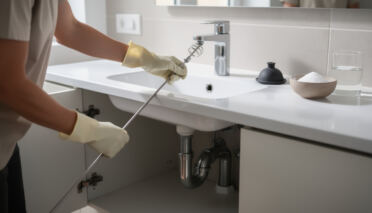
- 🚽 A solid plunger for quick clogs
Temporary fixes aren’t a lifestyle—they’re a bridge. If a pipe is actively leaking in a wall, or a shut-off won’t close fully, that’s when you escalate. The insight Maya keeps repeating is simple: control water first, diagnose second. That one habit prevents the “minor issue → major damage” storyline.
Choosing the Right Pipes and Connection Methods: Materials, Compatibility, and Code Reality
Most DIY plumbing problems aren’t caused by ambition—they’re caused by mixing the wrong materials or using the wrong connection method. A home’s pipes might be copper, PEX, CPVC, PVC, ABS, or some combination depending on age and remodel history. Each has a purpose, and they don’t all play nicely together without the right fittings and adhesives.
Maya’s house had copper for the water supply and PVC for drainage. When she replaced a section under a sink, she learned that drainage plastic isn’t just “plastic.” PVC and ABS use different solvent cements, and transitions need the correct coupling or approved transition cement based on local rules. Getting that wrong can create leaks, brittle joints, or straight-up code violations.
Pipe material cheat sheet (supply vs drainage)
| Material | Best use | Why homeowners like it | Watch-outs |
|---|---|---|---|
| 🟦 PVC | Drainage and venting | Lightweight, corrosion-resistant, easy to cut | Needs correct primer/cement; not for hot potable supply |
| ⬛ ABS | Drainage in many regions | Tough, fewer steps in some installs | Compatibility rules; check local code for use/repairs |
| 🟧 CPVC | Hot/cold water supply | Handles higher temps than PVC | Can be brittle with age; correct cement required |
| 🟩 PEX | Hot/cold water supply | Flexible, fewer joints, friendly for tight spaces | Needs proper crimp/clamp tools; UV exposure issues |
| 🟫 Copper | Hot/cold water supply | Durable, long lifespan, heat tolerant | Soldering skill; corrosion risks in some water conditions |
Connection methods matter as much as material. Threaded fittings need sealant tape or compound. Compression fittings need clean seating and correct torque. Solvent-welded joints need proper prep time and full cure. In 2026, a lot of “quick fix” culture gets pushed online, but plumbing doesn’t care about hacks—water will patiently find the weak point.
Also, venting and trap rules are not optional decoration. Codes exist because sanitation is serious: bad venting can lead to trap siphonage and sewer gas inside; cross-connections can contaminate potable lines. If you’re moving fixtures or changing vent paths, it’s smart to treat it like electrical work: DIY-friendly in pieces, professional-worthy when the scope touches system design.
For another visual deep-dive into DWV concepts and venting logic, this kind of explainer video makes the “air + gravity” relationship click.
Maintenance, Mistakes, and Odor Control: Keeping Drainage Smooth and Sewer Smells Out
Most people only think about plumbing when it fails. The better approach is to treat it like a car: small routine checks prevent expensive surprises. Maya’s routine is simple, seasonal, and realistic—because if a system is too complicated, nobody sticks with it.
Common homeowner mistakes that wreck pipes (slowly or suddenly)
Toilets aren’t trash cans. “Flushable” wipes don’t reliably break down, and they can snag in bends, build clogs, and stress the sewer system connection. Kitchen sinks aren’t grease disposal units either. Grease cools, turns waxy, and coats pipe walls until a small blockage becomes a full backup. And garbage disposals? Useful, but not magical—starchy foods and fibrous scraps can turn into paste or stringy mats that trap everything else.
- 🚽 Only toilet paper goes in toilets—no wipes, cotton balls, or paper towels.
- 🛢️ Keep grease out of sinks; pour it into a can, let it cool, toss it.
- 🍝 Avoid grinding rice, pasta, coffee grounds, and fibrous peels; trash or compost is safer.
- 🧪 Don’t rely on harsh chemical drain cleaners; they can damage certain materials and don’t fix root causes.
- 🧱 Never “make it fit” by mixing incompatible plastics or using the wrong cement—leaks love shortcuts.
Odors: the usual suspects and the quick tests
When Maya noticed a sewer-ish smell near the basement laundry drain, it wasn’t a broken main line. It was a dry trap. Floor drains and rarely used sinks can evaporate their trap water, especially in dry seasons or heated basements. The quick test is easy: run water for 10–20 seconds and see if the odor fades. If it does, you likely just refilled the seal. 💡
If the smell persists, the list expands: a clogged vent, a failing toilet wax ring, or bacterial buildup in a water heater can all cause unpleasant odors. Vent issues often come with slow drains or gurgling. Toilet seal issues might show up as faint odor around the base or slight rocking. When a drain is infrequently used, a one-way drain seal device (like an Oatey® Drain Seal) can block gases and pests while still letting water exit—handy for basements and laundry rooms where you don’t want to babysit trap water.
A realistic maintenance rhythm that doesn’t take over your life
Every few months, Maya does a quick “walk-and-look.” She checks under sinks for moisture, scans exposed pipes for corrosion or discoloration, and pays attention to how fast tubs and sinks clear. She also keeps gutters clean, because bad drainage outside can push water toward the foundation and create damp basements—problems that can indirectly stress plumbing runs and create mold-friendly conditions.
The key insight is that maintenance isn’t about perfection. It’s about noticing change. When you’re familiar with how your system normally sounds and behaves, you catch the small stuff early—before the wall stain becomes a reconstruction project.
When to DIY and When to Call a Pro: Spotting Layout-Level Problems Early
Some plumbing tasks are satisfying DIY wins: swapping a faucet, replacing a supply line, installing a new trap, snaking a shallow clog, or sealing a threaded joint. Others are layout problems wearing a disguise. Knowing the difference saves money—and sanity.
Warning signs that suggest more than a simple clog
Maya made a rule: if a symptom shows up in multiple places, she stops assuming it’s local. One slow sink is usually a local restriction. Multiple slow drains, especially with gurgling, can mean a venting problem or a developing main line obstruction. A persistent sewer odor that returns after refilling traps can hint at vent blockage or a compromised seal. Sudden damp spots on ceilings or walls often point to a supply leak hidden behind drywall, and those can escalate quickly.
- 💧 Stains or damp drywall: possible hidden leak—time matters.
- 🐌 Slow + gurgling drains: airflow or partial blockage, not just “hair in the tub.”
- 👃 Persistent sewer smell: trap/vent/seal issue, sometimes deeper line damage.
- 📈 Higher bill with no behavior change: leak until proven otherwise.
- 🚿 Whole-house pressure drop: regulator/main line/sediment or significant leak.
How pros think about your home layout
Licensed plumbers often approach a house like a system diagram: where’s the main shut-off, where’s the water heater, where are the stacks, where’s the building drain exit, and what’s the vent strategy? They also work within code constraints that protect health and property. That’s why “just move the sink over there” can trigger vent changes, drain slope requirements, and reworking a section of pipes you didn’t even know existed.
Even if you’re DIY-minded, you can adopt the same mindset. Before opening a wall, ask: “What else shares this wet wall? What’s above/below this spot? Where does this drain tie in?” That one pause prevents accidental damage to a supply line or vent—and keeps your project from spiraling.
The final insight to carry forward is simple: layout knowledge makes every decision cheaper, whether you’re doing the work yourself or hiring it out.
How do I find my home’s main water shut-off valve quickly?
Follow the main water line from where it enters the house. In many homes it’s in the basement or utility area; in warmer regions it may be outside near the foundation or in a ground box. Once you find it, label it and test it (turn off/on) once or twice a year so it doesn’t seize up. 🚰
Why do I sometimes smell sewer gas near a rarely used drain?
The most common cause is a dry P-trap: the water seal evaporates and lets sewer gases from the sewer system creep inside. Run water to refill the trap. If it keeps happening, consider a one-way drain seal for infrequently used drains and check for venting problems if odors persist. 👃
What’s the difference between water supply pipes and drainage pipes in terms of how they work?
Water supply lines rely on water pressure to push clean water to fixtures. Drainage lines rely on gravity to move wastewater away, and they need venting to balance air pressure so traps don’t siphon and drains don’t gurgle. 🔄
How often should I inspect my plumbing system?
A quick visual check every three to six months is a solid routine: look under sinks for moisture, scan exposed pipes for corrosion, and note any slow drains or odor. It’s low effort and catches small problems before they become expensive repairs. 🧰
How can I reduce the risk of frozen pipes in winter?
Insulate exposed pipes in basements, crawl spaces, and attics, and seal drafts near where pipes run. During extreme cold, letting a faucet drip slightly can keep water moving. If you have a history of freezing, a plumber can help identify vulnerable runs and improve your home layout’s protection. ❄️